Greetings y'all, warm wishes, and Happy New Year! Looking forward to a wonderful 2010, which I've been spending between Queens and scenic Ellenville, NY, with my ma and my pops. I'm en route to New Orleans to spend some time with the old school, the Nothin But Fire and Domino Sound krewes. I'll be out there till after Mardi Gras and getting down with my cumbia y otra cosas de Nuevo Orleans.
Here's Lado A of a 90 min cassette from DJ Tall Jamal - Cumbia Peruana Y Mas:
Grupo Hidra - Llore Llore Los Flamencos - Carinito Grupo California - Cuentame Los Bere Beres - Elsa Los Diablos Rojos - Nadia Estrella Juaneco Y Sus Combo - A Muerto Mi Abuela Bulgaros - Asi no Calinas - Batal Jam ll Grupo Mandarina - La Novena De Pluto
I just found a track by this group on an mp3 cd I bought down there and was brought in by the folklorica style vocals. Most chicha groups are male-fronted and they usually take cues from the Chacalon or American rock groups, while this female-fronted group embraces the folklorica influences of Alicia Delgado and Sonia Morales.
Spinnin those jams I love tonight at Trophy Bar! I went to their Dirty South party last night and had a wild one- people still dance on weekday nights and I'm loving it.
Go Shout Plenty! 10 PM - Monday, December 21st ((third Monday every month)) Trophy Bar - 351 Broadway - M to Marcy, L/G to Lorimer
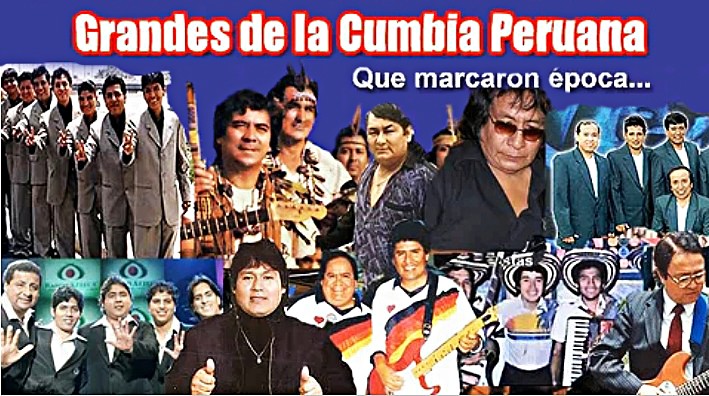
Just joined the Latino media messageboard Taringa.com and found this entry that highlights the top ten Cumbia Peruana acts, Grandes de la Cumbia Peruana
Here's a video of his Top 10:
As commenter johnnystuk says,
"los shapis, chacalon musica exclusiva de delincuentes"
I've been reading this book "Black Rhythms of Peru" about African influence on culture in Peru and what Paul Gilroy refers to as "the Black Pacific." The book talks about the revival of folklore by White Criollo (person of Peruvian and European heritage born in Peru) Jose Durand. His revivalist Pancho Fierro dance company in the 1950's played the highest venues in Lima and laid the groundwork for the 1960s contribution of Victoria and Nicomedes Santa-Cruz's company Camanana.
Whether Durand's influence has been positive or negative is debated. Some argue that he molded the stage show to appeal to audiences and downplayed the erotic nature of the plays, suggesting that he removed this element from the show. Others argue that the plays were never erotic, they were just expected to be by virtue of African stereotypes. He is, however, criticized for the direction that Afro-Peruvian culture went in the 1950s.
The Santa-Cruz's group Cumanana was based on the coreography of Victoria and toured internationally. The plays were crafted by Nicomedes and one satirical one suggests the subtle racism in musical notation. A professor is teaching the students quarter and half notes, respectively the black and white notes. When the professor has to leave the room for something, the students quarrel and wonder why "two black notes equals one white note."
Victoria's coreography is based on the idea of "ancestral memory," which shows diasporic consciousness on the Black Pacific in her works. "Academic pursuits are how the mind colonizes the body," she suggests and I gotta keep that in mind when I retrun to academia next year for ethnomusicology.
Here's a clip from a Cumanana piece "Me gritaron negra" ("I Shouted Black")
Extremely important piece! When I told a Peruvian that I went to Chincha, the heart of Afro-Peruvian culture, she often motioned to her face and say, "Los Morenos" (the Browns). Such responses are not often generated in other Black Atlantic countries, making Afro-Peruvian culture a more interesting topic to investigate.
I finally am able to listen to all the records I got down in Peru! Oh man, what a wait- it's been two months since I've been back and I haven't been in the same place/time as my records and player. What a tease, but I finally dove into them today and it's pure bliss.
I found this little medley off the Cumbia Thriller album by Los Mirlos. They start off with a cumbia version of MJ's "Thriller" (this version recorded in 1984), then go into a blend of their exitos starting with La Danza de Los Mirlos, La Danza de Petrolero, and Eres Mentirosa.
Off to a good start! More comin'!
p.s. don't really know what's up with the font two posts below. Tried fixing it about 5 times and can't get it right.
Got a bag of records for grazing on, plus some West African loves on mine on display this Monday! I'm making a few batches of some sorrel to keep drinks cheap for ya! $3 sorrel and rum after midnight, $5 otherwise.
Funny song here by big-time chicha act Los Shapis - La Novia (the Girlfriend)
A story of a poor fellow who goes to church to atone for his sins and there happens to be a wedding going on. But say, who is that bride? She looks very familiar...is that my sis...wait a sec- that's my girlfriend with some other guy! Los Shapis - La Novia
Los Shapis played a truer style of Huayño, an already fused mixture of Andean folk and city-dance music, than other chicha groups like Los Mirlos, Los Diablos Rojos and Los Destellos. While the other groups embraced more guitar elements in their work, Los Shapis embraced their country roots a bit more.
Their songs, like the one above, talked about emotional hardships, drinking, and the failures of love. The following "Juguetito" ("Little Toy") features some great synths and female vocals:
Of course, since the genre of chicha is named after a low-strength corn beer drank by the Incas, a good bit of drinking is involved in the genre. This song laments the curse of being a drunk as a way to deal with one's problems:
Originally hailing from the San Martin district, a region of northestern Peru that is about half-way between capital city Lima and capital city of Quito, Ecuador, the group who came to be Los Mirlos (The Blackbirds) brought the chicha sound to Lima in 1971. Chicha, as mentioned a few times on here, came about from the Andean mountain music fused with the fiery Colombian cumbia that was gaining popularity in Lima.
Forming in 1968 under the name Los Saetas (The Bolts), brothers Jorge and Carlos Rodriguez Grández incorporated the jungle sound popularized by groups like Juaneco and Sus Combo with a unique use of guitars and accordians. The accordian was mostly dropped en route to Lima and the band is remembered for their reverb-heavy surf guitar rock over a steady cumbia beat and regionally proud lyrics.
The influential guitar work on "La Danza de Los Mirlos" ("The Dance of Los Mirlos") is the unofficial cumbia guitar anthem until today.
The distinctive melody can be found in many fan versions all over Youtube. Here's a little punk clip by an unknown Peruvian band:
And some bedroom rock!
Taking on a more pointed political and joking approach, "La Danza Del Petrolero" ("The Dance of the Petrol/Oilman") portray oil hungry folks as buffoons.
(b. Peru-Lima, 29 November 1940 – † Peru-Lima, 9 October 2009),
Better known by his fans by the pseudonym of “Zambo Cavero”. He was a virtuoso Afro Peruvian singer, who enjoys international fame. He was considered by many Peruvians a symbol of the Afro Peruvian identity or Peruanidad because of his particular manner of singing that captivates his listeners, many of whom coincide that Cavero’s intensity makes then feel the melodies with a truly Peruvian taste, as a result in his long artistic trajectory, he was very popular, admired and loved, not only in Perú, but by many people from different parts of the world in which he sold his musical reproductions. “Zambo Cavero” specialized in interpreting, with a unique talent and inimitable voice, traditional songs from authentic and original rhythms of Perú, some of his best interpretations are songs that were composed by the notable Peruvian composer Augusto Polo Campos, other comes from a profound Afro-Peruvian traditional Música criolla which is actually Afro Peruvian music.
Greetings from scenic Roanoke, VA! I was en route from Brooklyn to New Orleans when we had to stop in Roanoke because my dad was feeling some sharp stomach pains. He had appendicitis and had the appendectomy on Thursday, still in convalescence today.
Here's a little folkloric jam by youngster Wendy Sulca showing love for the Papito (little father)-
It's been a grim year for music losses. Of course, we had a King of Pop, the Princess of Andean Folk, and, although she's without a royal title, Argentinian folk icon Mercedes Sosa as well. Lovingly called La Negra for her dark hair, the singer passed away this past Sunday of kidney failure at the age of 74.
Back in the 70s, she recorded a version of Violetta Parra's "Gracias a la Vida" - "Thanks to Life," which became a prized song for South American leftists in those tumultuous times. Coming from the working-class sugar town of Tucuman, she became a member of the Communist Party in 1976, the start of the military dictatorship of General Jorge Rafael Videla during Argentina's "Dirty War." Her music was banned from airplay and was exiled to France and Spain in 1979, spending three years there before returning.
She came back this year with a big collaboration project "Cantora," which was ranked #1 in literally every Argentinian music store I went into this past August and also nominated for three awards at the upcoming Latin Grammy awards.
Thank you, the Black One, for your song and your struggle.
Alcoholism exists all over the globe for a lot of reasons, no? Other species get what the Irish call "The Thirst," as shown in the BBC segment on boozy monkeys. Then, we also see higher rates of alcoholism on low-income communities.
It's kind of a grim subject to breach on an otherwise light-hearted blog, but the drink often gets weaved into Peruvian music because it's a big part of chillin culture. Like I brought up in this piece, chicha music gets its name from the low strength, Incan corn beer that costs maybe $.13 American dolores. It's common to go through maybe 8-10 of these 16-20oz jars before wrapping up for the night and walking a surprisingly straight line back to wherever you're staying.
This song I came across at the "black market" near the bus station in Cuzco. I kinda also figured out the slang term for cash-money, which is plata. They're telling their friend to pay the chicha bill if he has money, ("Si tienes plata"), but he doesn't. It's always the question of the night and this song, with initial boozy banter over the start. Cop it!
The trio Los Kipus have been playing together for 50 years and taking traditional Peruvian folk with the occasional cumbia organ. They formed in 1955 when Luis Abanto Morales and Paco Maceda were 21, with Marcela Luna joining slightly later.
Great keys and vocal harmonies here and the video is a photo of a a girl from Chivay near Canyon Del Colca in Peru, who are known for their amazing hats (photo from my journey there below vid):
I'm back in the US, my dog is great, and I'm able to sit down and digest these jams with my own computer, finally being able to make some mixes of what I've been immersed in for a past few months. Here are a couple of covers of the Los Hijos del Sol's big track "Cariñito." The track is often covered by local bands during live shows or put onto demos, always a staple to perfect if you want to get a lot of gigs. Here are a couple different takes on it, separated by about 25 years and varying in sound quality.
This version done by Los Flamencos has a slightly out of tune keyboard/guitar dynamic going on, not totally sharp, but a nice grainy production quality, making it as raw as your first attempts with a 4-track. They were part of the Iquitos jungle sound with other bands like Juaneco Y Sus Combo. Tune in on this: Los Flamencos - Cariñito
Now here goes a version by cumbia/reggae/ska group Bareto, hometown heroes of the Barranco neighborhood in Lima. Of course, it's blessed with a pair of real life calendar girls shakin it on stage with them. I picked up a Barato mixtape and this song was not on it, so not sure if there's actually a recorded version of it.
Here's a version by a group who's name I haven't discovered yet. All these videos so far mandate a lot of booty for this particular track.
And then the original version performed live by Los Hijos Del Sol (with booty):
I´ve been very lucky on this trip because I´ve been finding some really great jams on the daily basis in formats that don´t usually function with the hostel I´m staying at. But luckily tonight, in Mendoza, Argentina, I found a place with a tape player. I thought I´d only be able to listen to tapes in my mom´s Buick, driving to get pastries at Cohen´s Bakery, but they had one here.
I had a long week in Buenos Aires. It´s very easy to have big nights there- starting your dinner at midnight, wrapping up around two, and then dancing till dawn with no probelms, which happened 7/8 nights. But on my last day, deciding whether to stay for the night or not, I walked around and found a cassette of Charly Garcia´s at a flea market (the "Modern Clicks" or "Clix Moderno" album), that sold choripan and G-N-R shirts.
I posted an item about him earlier and was not expecting to write about him again, buy the tape was great- really stellar 80s jams with a darker influence that Argentinians really love. Perfect mix of hostel resources and things I´ve been grazing on to make my night complete.
Before I get on the uploading of the tape, take a look at some more insight on Charly Garcia. The tape drove me to Youtube.gov:
an interview:
I really wasn´t wild about the Che song from below, but Argentinian enthusiasm for this man made me but the tape (see the comments on this vid). I hate to attach a western comparison to him, but he has the pop sensibilities of Elvis Costello and the lunacy of Charles Manson, save the bloodshed, all wrapped nearly 30 years of recording.
Here´s the track off the 1983 album "Modern Clix" that got me feelin him again:
This band is exciting! Lead singer Ali Gau Gau moved from Mexico to Buenos Aires wanting to start some kind of new cumbia with punk influences. After coming up with the killer name "Kumbia Queers," the band formed and started doing cumbia covers of Sabbath, The Cure, and Madonna.
Everywhere you go in South America, homes, restaurants, etc., they have calendars of beer ads with very scantily clad women on them. I have seen one directly next to a photo of the Virgin Mary, too. Here´s a little homage to them:
Kumbia Queers - Chica De Calendario
With the Cure´s "Lovesong" as the backing track, Kumbia Dark got me laughing:
Some wild, electrocumbia and dub mash ups here, with jams from Buju Banton, Prince, Marvin Gaye and some modern cumbia. Got in touch with these guys through my main point of contact here, cool fellow who runs La Cigale bar and a friend of DJ Dub Insurgent from back in New Orleans.
They have some electrocumbia parties at Club 69 and they´re having another one tonight at Niceto Club on Nicete Vega 5510. Get down if you´re in town!
Upon arrival in the town of San Carlos de Bariloche, Argentina, I sought out chomp on some famous Argentinian steak. Steak and wine, I thought, would be my diet for the rest of the month. So far on this trip, every expectation I had of each country has been wrong. I thought that the loathing Chileans whad for former dictator Augustus Pinochet would be so viscous that I´d be able to swipe it off the walls of La Moneda (the Presidential palace), where his army overthrew and killed democratically elected President Salvador Allende on September 11th, 1973. That wasn´t the case - most Chileans still hate him, but they´re over it; they´ve got a progressive woman president in Michelle Bachelet. They´re looking into the future and not dwelling on the past.
I thought Bolivia would be more dangerous than it was, as well. My friend and I went to an Iron Maiden tribute show in La Paz and most of the guys with nicks and cuts on their faces wanted to give us some beer, not take our wallets. So one thing this trip taught me is to never have preconceived notions about anything while travelling. That was until I discovered the magic of Argentinian steak. It certainly lives up to its rep.
Another thing I noticed is that radio here only plays Argentinian music. In Peru and Bolivia, I heard everything from Rick Astley to Pearl Jam, with only a few songs in Spanish on popular radio. There are several reasons for this. Argentina is quite larger than other countries down here and has quite a booming music industry. The 80s music at almost any club in South America is probably from here.
Argentina´s pride and joy is a fella named Charly Garcia. Charly, fresh out of rehab, has a new single about all the folks who wear Che Guevara shirts. Charly says, "Hey, if you wear the shirt...You should know why."
Sorry for fewer updates! The jams are still here, but the connection is daaaaaaaaaaang slow. Like, I tried uploading a zip file to megaupload and it failed three times.